This review panel features responses from a range of scholars working in Biblical Studies and late antiquity, originally shared at the 2025 Annual Meeting of the North American Patristics Society.
In Earthquakes and Gardens, Burrus pulls a few short lines from the very end of Jerome’s Life of Hilarion and applies immense analytical pressure to them. It is a mode of historiography as spoliation.
This review panel features responses from a range of scholars working in Biblical Studies and late antiquity, originally shared at the 2025 Annual Meeting of the North American Patristics Society.
Historians often try to reconstruct places; they map areas to give readers a sense of a whole. I am grateful for that work. But Burrus reminds us that humans do not really experience places as whole.
We may, in fact, be approaching a moment when historical literacy—much like philology—ought to be regarded as a basic expectation of rigorous scholarship on the Talmud. If so, the question before us is not only what the Talmud is, but also what forms of training, institutional support, and scholarly habits are required to render that question newly intelligible.
The book historical question that I will focus on here is the question of the Talmud’s initial reception, of what we may call its canonization. And I mean this not in the sense of its coalescing as a work, though that is still profoundly unclear, but in the sense of how the Talmud became the most central work for defining what Judaism is and should be—well before, even a millennium before, it became a popular book and a part of popular piety.
[O]ne major and simple contribution that Bavli Studies can make as a recognized (sub)field is to bring together scholars studying the Bavli’s formation and those studying its reception history.
In anticipation of the publication of the conference proceedings, the volume editors convened a roundtable discussion at the 2025 Association for Jewish Studies annual conference.At the roundtable, several scholars discussed the question "What is the Talmud?" and considered how diverse answers to that question have shaped and will continue to shape the field of Bavli Studies. The responses by Alyssa Gray, Simcha Gross, and Yitz Landes are presented below.
It is my hope that scholars who specialize in the study of texts will recognize that archaeology is not only relevant but indeed vital to their own research.
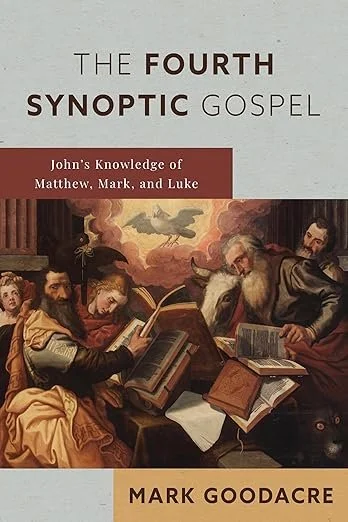
In The Fourth Synoptic Gospel, Mark Goodacre challenges this perspective and attempts to demonstrate that the author of the fourth gospel was not only aware of the Synoptic Gospels but also used them in the writing of their gospel text.
Graf serves as an able guide for readers through the complex ideas of Stoicism, Seneca’s philosophical vision, and affect theory. Readers less familiar with Senecan ideas will likely find this book a helpful introduction.
In Unfinished Christians, Frank focuses on literary records produced in and for shared spaces, liturgical and otherwise, where ordinary Christians would have gathered for various religious rites.
The intended audience for CIIP 5 consists of scholars specializing in the study of early Judaism, early to late antique Christianity, and the early Islamic period. However, given that every inscription is translated into English, non-specialists interested in any of these time periods in this location will benefit from this epigraphic collection.
He moves the question of reception away from strictly exegetical approaches that look for a history of interpretation within a world of ideas, and towards how Jews in Late Antiquity encountered physical scrolls of psalms, how they incorporated them into their liturgical practices, and how psalms played a role in practical religion (e.g., piety and magic).